Glycerine appears as a colorless to brown colored liquid. Combustible but may require some effort to ignite. Glycerol is a triol with a structure of propane substituted at positions 1, 2 and 3 by hydroxy groups. It has a role as an osmolyte, a solvent, a detergent, a human metabolite, an algal metabolite, a Saccharomyces cerevisiae metabolite, an Escherichia coli metabolite, a mouse metabolite and a geroprotector. It is an alditol and a triol. A trihydroxy sugar alcohol that is an intermediate in carbohydrate and lipid metabolism.
Glycerol has a wide range of applications, including in the food and beverage, pharmaceutical, and cosmetic industries.
Synonyms: glycerol; glycerin; Glycerine; PROPANE-1,2,3-TRIOL
Cas Number: 56-81-5
Physical State (20 deg.C): Liquid
Appearance: Colorless clear liquid
Purity(GC): min. 99.0 %
Molecular Weight: 92.09 g/mol
Boiling Point: 290 °C at 760 mmHg
Melting Point: 18.1 °C
Flash Point: 177 °C
Density: 1.261 at 20 °C
Vapor Pressure: 0.0025 mmHg at 50 °C
Autoignition Temperature: 393 °C
Viscosity: 954 CENTIPOISES AT 25 °C
pH: Neutral to litmus

Glycerin
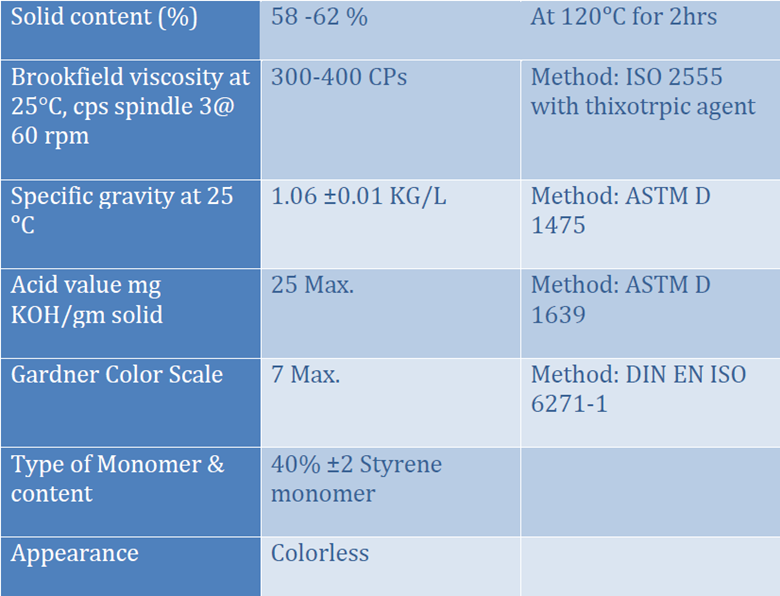

Curing properties are those obtained using 2% Cobalt Octoate (1% cobalt metal) & 2% MEK Peroxide (M50) in 100 grams of resin previously stabilized at 25°C.
Storage: In Drums/ IBC’s: Product should be kept in temperature below 25°C. Direct heat sources such as sun light must be avoided as it decreases product’s shelf life. drums or tanks should be kept well sealed to avoid moisture or monomer loss.
Annual Production: 9,000 tons.
=